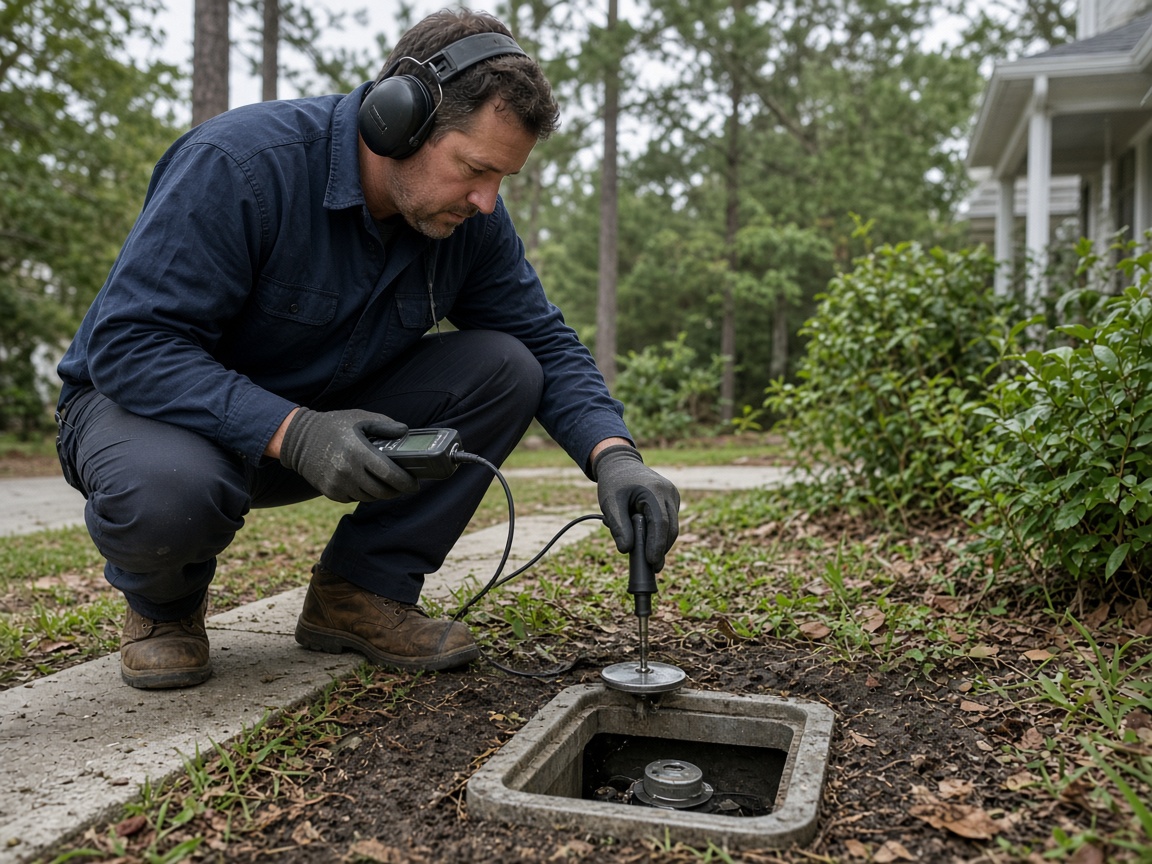
Tallahassee's humid subtropical climate brings frequent summer storms and mild winters that keep soil moisture high around older plumbing in Downtown and College Town. Many homes built before 1980 still have galvanized or cast-iron lines that corrode from the inside, creating slow leaks that travel under slabs or along foundations. Electronic listening devices and acoustic sensors locate these without demolition, which matters when the terrain slopes toward St. Marks National Wildlife Refuge and water migrates quickly toward lower lots.
Newer subdivisions like Southwood and Killearn Estates often have PEX or copper runs that fail at joints after repeated expansion from hot summers. Roof leaks around flashing near Doak Campbell Stadium or the Florida State Capitol area are common because of wind-driven rain and aging shingles. Thermal imaging combined with moisture meters distinguishes condensation from actual pipe breaches, preventing unnecessary wall removal in Midtown duplexes where shared walls complicate access.
Underground leaks near Florida State University campus frequently involve irrigation or sewer lines buried in clay-heavy Leon County soil that shifts with heavy rain. Technicians trace these lines from the meter outward, marking the exact entry point before excavation. This approach avoids disturbing mature landscaping common in Killearn Estates while stopping water from reaching the foundation.
Nearby cities such as Panama City and Valdosta share similar storm patterns, but Tallahassee's mix of historic and post-2000 construction requires technicians to adapt methods on every call rather than using a single technique.
Technician insight
In Tallahassee the thing that catches most people out with Leak Detection is condensation from our humid summers being mistaken for pipe leaks, especially in Killearn Estates crawlspaces where poor ventilation keeps everything damp. Older galvanized lines in Downtown homes often leak at the joints rather than the middle, so you have to listen at every fitting instead of assuming a straight run.
Hidden Slab Leak Near Midtown
A homeowner in Midtown noticed warm floors and rising water bills after summer storms. Scans showed a pinhole in a 1970s copper line under the slab. The line was isolated at the meter, the leak pinpointed within two feet, and repair access was limited to a single 18-inch opening in the utility room floor.
Leak Detection Services We Offer
✓Electronic Leak Detection
Uses acoustic sensors to pinpoint pressurized pipe leaks behind walls or under slabs without cutting drywall in Tallahassee homes.
✓Thermal Imaging Leak Detection
Infrared cameras reveal temperature differences caused by hidden moisture from roof or plumbing leaks in Killearn Estates attics.
✓Slab Leak Detection
Locates leaks under concrete foundations common in Southwood and Midtown properties using non-invasive listening equipment.
✓Roof and Flashing Leak Detection
Traces wind-driven rain entry points around chimneys and valleys in older Downtown and College Town roofs.
✓Sewer Line Leak Detection
Camera and pressure testing identify breaks in clay or cast-iron lines affected by shifting Leon County soils.
Leak Detection Cost in Florida
| Service | Typical Range | What Affects It |
|---|---|---|
| Standard interior leak scan | $225–$375 | Single-story homes in Midtown or College Town; one method. |
| Slab or underground detection | $350–$550 | Includes meter-to-foundation tracing in Southwood or Killearn Estates. |
| Roof and attic scan | $275–$425 | Thermal plus visual; steeper roofs or two-story structures increase time. |
| Multi-area or commercial scan | $450–$750 | Larger footprints near Florida State University or the Capitol. |
Ranges are typical for Florida and confirmed with an exact written quote before any work starts.
How it works
- 1
Site Assessment
Technician arrives in the specified Tallahassee neighborhood and reviews visible moisture patterns and homeowner reports.
- 2
Equipment Deployment
Electronic or thermal tools are set up to scan walls, floors, and ceilings without demolition.
- 3
Source Isolation
Readings narrow the leak to a precise location, noting proximity to nearby landmarks or property lines.
- 4
Documentation And Recommendation
Findings are mapped and repair options are explained with attention to local soil and weather conditions.
Pricing
Pricing based on property size, access difficulty, and whether multiple detection methods are required.